|
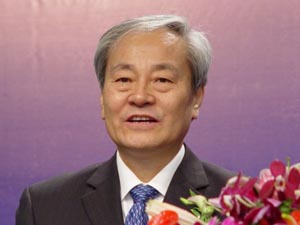
Du Yuzhou, President of China
National Textile and Apparel Council
Ladies and Gentlemen,
We are greatly honored that Chairman Xu, Minster
Bo, Mr. Harbinson, and Mr. Munir Ahmad join us
in this forum and give keynote speeches on invitation,
to make this forum more authoritative and influential.
As the President of CNTAC, it is honorable to
be here, to exchange ideas and to listen to penetrating
views with heads and prestigious entrepreneurs
in textile industry from so many countries and
regions. I would like to talk over two issues
in the beginning.
First, two main trends of global textile industrial
development and their great effects on the strategic
choices of the textile industry for each country
1. Wide application of high and new technology
accelerates the upgrade of global textile Industry
and goes deep into individual's real life.
On one hand, it continually rouses higher demands
of individuals in clothing consumption, by seeking
high quality, high function, high affectivity,
green consumption, and individualized expression
of multiculturalism.
On the other hand, the wide application of high
and new technology accelerates the updating and
renovation of traditional textile technology.
Taking computer science technology, digital technology,
and information technology as the core, driving
the combination and amalgamation of various modern
subjects and technologies, it creates high qualities,
innovations and quick response abilities for modern
textile industry that have never appeared before
in many aspects, such as fiber, processing, equipment,
distribution, management, design and research
& development.
The increasingly globalized modern manufacturing
mode transforms the competition focus from the
comparative advantages in labor-intensive size
to the innovative advantages in playing a decisive
role in the value-added supply chain.
2. Further economic globalization accelerates
global horizontal structural adjustment.
Globalization urges optimized international and
trans-regional allocation of productive factors
in textile industry to upgrade the productivity
to a large extent.
Along with the gradual decrease of trade barriers,
the international trade in textile industry gradually
increase. From 1990 to 2004, the world fiber processing
gross increased 50%, while the trade of fiber
products increased 100%. And this will be a continuous
growth momentum in the coming five years.
(In US$100 million )
|
|
|
|
1990
|
2004
|
Growth Rates
|
|
World
|
Export
|
Textile
|
1043.54
|
1947.32
|
86.61%
|
|
Clothing
|
1081.29
|
2580.97
|
138.69%
|
|
Developing Countries
|
Export
|
Textile
|
386.83
|
902.00
|
133.81%
|
|
Clothing
|
705.88
|
1429.50
|
102.51%
|
|
Import
|
Textile
|
644.92
|
963.52
|
49.40%
|
|
Clothing
|
306.76
|
338.02
|
10.19%
|
|
Developed Countries
|
Export
|
Textile
|
657.79
|
1045.00
|
58.87%
|
|
Clothing
|
376.76
|
1151.40
|
205.61%
|
|
Import
|
Textile
|
398.62
|
983.48
|
146.72%
|
|
Clothing
|
774.53
|
2242.98
|
189.59%
|
Source: WTO
As is known, the faster the technological progress
has been made in developed countries, the more
mature manufacturing technologies will be shifted
to other countries. This shift does not mean a
decline of the whole industry. The shift, on one
hand, provides developed countries a much bigger
opportunities in researching and developing technologies
to upgrade core competitiveness; on the other
hand, it utilizes production quality and low cost
labor in developing countries, to reduce the total
cost of international manufacturing, and gain
greater profit in international industry. From
1990 to 2004, the amount of textile and apparel
export in developed countries remained an increasing
of 122.3%, accounted for 48.5% of the global export.
Developing countries ,on one hand, gain developing
opportunities to be merged into globalization
by carrying on low-end manufacturing part; on
the other hand, by utilizing the effects of knowledge
spillovers and upgrading innovative abilities
to bring the late-developing advantages, they
accomplish industrial upgrade and leap-forward
development.
Each country has its unique comparative advantages
in different parts of the industry. Even between
developed countries and developing countries,
there are complementary relationships. The horizontal
structural realignment of the industry has become
the mainstream of the shift of the contemporary
textile industrial structure.
3. Under the new circumstances of international
textile industry, each country has to make new
strategic choices, all without exception.
Developed countries or developing countries, with
abundant or lean resources, under the new circumstances,
in spite of different opportunities, different
levels and paths of development, all have one
thing in common, that is, each country cannot
stay away from the cooperative and competitive
global relationship, and all are situated in the
system of "opening, cooperation and win-win
development".
The practice tells us that free trade is the historical
trend and the retrogressive trade protectionism
will eventually come off the stage. The horizontal
shift of global textile structure has already
provided developed and developing countries more
means of production and livelihood, as well as
different opportunities. The horizontal structural
shift of the industry is a complicated cyclic
developing process which is full of adjustment,
cooperation, competition. The process is full
of developing opportunities as well as failure
risks. Developed countries may gain more profit
from international allocation as well as being
faced with the challenges of late-developing advantages
from developing countries; while developing countries
may obtain opportunities from international allocation
as well as confronting the risks of losing independent
status. Therefore, as the trait of contemporary
global textile industry, opening, cooperation
and win-win development embodies the strategic
choices for almost all the countries.
Second, the historical conditions of China
textile industry's persistently high growth and
the certain choice of changing the economic growth
pattern
1. China textile industry's persistently high
growth is mainly contributed by the persistently
high growth of domestic demand.
Since 1980, China has achieved its modernization
drive goals systematically. Now it is in the effort
to mainly achieve industrialization by 2020, build
a moderately prosperous society in all respects,
and reach the standard of moderately developed
countries in the middle of 21th century.
Domestic demand remains the first impetus of China
textile industry. After the reform which has lasted
for a quarter of century, China has already become
the biggest market in the world for fiber consumption.
The amount of per capita fiber consumption developed
from 4.1 kg per person to 14 kg per person. The
growth between 2000 and 2005 gained an increase
of 50% over the previous 20 years.
In 1980, the population in China was 987 million,
with 19.40% for urban population. Up to 2005,
the number has reached 1,308 billion, with 43%
for urban population.
From 1981 to 2000, the per capita GDP was less
than US$ 1,000, with an average annual increase
of 8.32% percent. The per capita clothing consumption
generally increased in the same pace with GDP.
From 2000 to 2005, China's per capita GDP increased
to over US$ 1,000, with an average annual increase
of 8.8%. The average annual increase of per capita
clothing consumption was 13.8%. (Comparable prices)
During the past five years, among enterprises
above the designated size (each with annual sales
revenue of five million Yuan), value of product
sales rose 1.3 times, while the proportion of
export delivery value declined from 33% in 2000
to 28% in 2005.
During the process of China's Industrialization,
textile industry has a special significance to
many issues like economic and social development,
increasing employment, and solving the problems
of agriculture, rural areas and farmers. Currently,
the annual Incoming labor force reaches 10 million
populations in cities and towns, surplus rural
labor 150 million still , the registered unemployment
rate in cities and towns is 4.2%, the proportion
of service industry is only 31.3%, and the rate
of urbanization only accounts for 43%.
Currently, China textile industry owns about 19.6
million employees, with about 14 million coming
from rural areas, gaining more than 100 billion
Yuan as annual salaries. Among the enterprises
above the designated size in China (with annual
sales revenue of 5 million Yuan), the portion
of employees in textile industry is 14.12%.
The using of more than 7.3 million tons of homemade
natural fiber in textile industry bears on the
bread and butter issue of 100 million farmers.
Thanks to the development of textile industry,
a great number of rural areas took the lead in
accomplishing urbanization.
In 2005, the textile industry turned out an international
trade surplus that accounts for 98.58% of the
nation's total favorable trade balance, with its
influence coefficient to national economy for
1.25, showing its unchanged pillar status in the
new era.
2. Following the strategy of opening wider to
the outside world for a long time is important
for China textile industry's persistently high
growth.
-- Taping its comparative advantages, the textile
industry takes an active part in international
division of labor and cooperation, imports advanced
technologies and management, absorbs foreign investment,
expands international contacts, exchanges and
trade, and drives development and progress of
the whole industry.
-- China textile industry is engaged in cooperation
with other countries & regions, and the textile
and apparel exports totaled US$117.5 billion in
2005, with 32.7% to former quota regions including
the US, the EU, etc., and 67.3% to former quota-free
regions. From 2001 to 2005, China's import of
cotton rose from 110,000 tons to 2.65 million
tons, and import of raw materials for man-made
fiber went up from 5.6 million tons to 13.08 million
tons, and the import of textile machinery amounted
to US$18.9 billion. The actual utilization of
foreign investment (paid-in FDI) reached US$ 22.86
billion in the textile industry.
Import of China
Textile Industry from 2000 to 2005
Unit:
A (in 10 thousand tons) or B (in US$ 100 million)
|
Year
|
Cotton
(A)
|
Wool
(A)
|
Monomers
for MMF (A)
|
Man-made
Fiber (A)
|
Textile
Machinery (B)
|
Dyeing
Stuff (A)
|
Textiles
(B)
|
Clothing
(B)
|
|
2000
|
8.4
|
30.07
|
450.47
|
165.3
|
19.13
|
4.21
|
127.03
|
11.84
|
|
2001
|
11.26
|
30.91
|
559.58
|
147.3
|
25.14
|
4.63
|
124.58
|
12.62
|
|
2002
|
20.8
|
23.72
|
754.91
|
172
|
35.19
|
5.63
|
130.26
|
13.37
|
|
2003
|
87
|
19.27
|
904.52
|
185.8
|
46.11
|
10.8
|
141.83
|
14.04
|
|
2004
|
198
|
23.92
|
1126.83
|
177.68
|
47.55
|
11.02
|
152.73
|
15.31
|
|
2005
|
265
|
26.9
|
1308.77
|
170.01
|
35.56
|
11.11
|
154.9
|
16.09
|
|
2005/2000
|
3054.76
|
-10.54
|
190.53
|
2.85
|
85.89
|
163.90
|
21.94
|
35.90
|
|
Growth
Rates %
|
Source:
China Customs
Foreign Capital Utilization of China Textile Industry from 2000 to 2005
(US$ 100million)
|
Year
|
Projects
|
Contractual
Foreign Investment
|
Paid
in Capital
|
|
This
Year
|
Change
From Previous Corresponding
Period ±%
|
This
year
|
Change
From Previous Corresponding
Period ±%
|
This
year
|
Change
From Previous Corresponding
Period ±%
|
|
Total
|
23827
|
|
498.95
|
|
228.61
|
|
|
2001
|
3014
|
26.11
|
45.10
|
34.39
|
31.67
|
42.85
|
|
2002
|
4672
|
55.01
|
74.91
|
66.10
|
45.78
|
44.55
|
|
2003
|
5707
|
22.15
|
103.75
|
38.50
|
48.67
|
6.31
|
|
2004
|
5577
|
-2.28
|
129.39
|
24.71
|
53.16
|
9.23
|
|
2005
|
4627
|
-17.03
|
145.80
|
12.69
|
49.33
|
-7.20
|
-- Currently, of the paid in capital of the enterprises
above the designated size in textile industry
(with annual sales revenue of 5 million Yuan),
1/3 is invested by Hong Kong, Macao, Taiwan and
foreign capital. The export of enterprises invested
by Hong Kong, Macao, Taiwan and foreign capital
accounts for 34.3% in total export( US$117.5 billion
in 2005) of China's textile and apparel.
-- After being a member of WTO, China carries
out its pledge and undertakes obligation.
Chinese import tariff generally drops to the point
already below the averaged level of the developing
countries, with that of industrial goods down
to about 9%. China has signed up FTA with Chile,
and the FTA with ASEAN will be established before
2010. China has also granted tariff-zero treatment
to the thirty-nine least-developed countries (LDCs)
that have diplomatic relationship with China for
their products, including textile.
--International brands for clothes have lassoed
a growing market share in some metropolitan cities
in China.
Take Beijing's 35 middle and high-end markets
for instance, international brands account for
42% of 5940 sale booths. In the slap-up marts,(
Peninsula-Palace Hotel, Scitech, Yansha Mall)
80% of the brands are international and overseas.
--In Shanghai's Huaihai Road, a famous shopping
street, is busy with 1159 brands of garment, 60%
of them are also international and overseas.
--Multinational retailers entered China, and their
business phases in bigger size
Only 18 foreign enterprises accessed to Chinese
retail business before 1997, and the number of
foreign retailers yet to be approved had grown
to 314 by the end of 2004. In the first half of
2005, 59 international retailers got Chinese approval
for new establishments in China, 1.9 times higher
than that in 2004. The seven large foreign retailers
(Wal-Mart, Carrefour, Metro, Auchan, Lotus, Trustmart,
Loogoo) have their business presence for 306 chain
stores in 59 big cities in China. Foreign investment
represents over 61% of the total large supermarkets
in our country.
Chinese textile industry supports our enterprises
to develop textile business by investment, joint
venture and cooperative running in some developing
countries. In 2005, as entrusted by Ministry of
Commerce, we staged training programs for 66 textile
executives and government officials from 17 African
countries with respect to cotton, cotton textile
production and trade projects ( namely, Ethiopia,
Nigeria, Sierra Leone, Seychelles, Tanzania, Togo,
Uganda, Zambia, Zimbabwe, Benin, Central Africa,
Eritrea, Ghana, Kenya, Lesotho, Mauritania, Mauritius)
China National Textile and Apparel Council, at
the invitation of Ethiopian government, also organized
our experts to pay a field visit to map out a
ten-year development program for cotton, textiles
& apparel industry there.
Some of our backbone enterprises have already
staged investment and brands cooperation in some
developed countries and regions to set up business
development & marketing agencies .
3. Market-Driven Reform is the Powerhouse to Engine
the Sustained and Rapid Growth of Textile Industry
in China
In 2005, of the total paid-in capitals in the
above-scale enterprises, non-governmental and
foreign capitals accounted for 94%. Also in the
same year, of the investment in the fixed assets
of textile industry, domestic bank loans accounted
for 9.32%, overseas funds for 13.89%, and corporate
own capitals for 72%.
The marketization progress speeds up the development
of industrial clustering belt in the eastern area
of the country, the production of these industrial
clustering takes hold of 80% of the nation's total.
Right now, there are over 280 specialized markets
of its kind, whose individual annual sales going
between 100 million and 20 billion yuan.
The systems for investment and for the development
of science and technology are undergoing market-oriented
reform, which has greatly facilitated development
of textile industrial chains in a more coordinated
way. At present, the man-made fiber takes up 65%
of the total fiber consumptions in China. As regards
the newly-added 10, million tons of man-made fiber
capacity in the past five years, the overwhelming
production of the polyester fiber that represents
about 80% of Chinese man-made fiber production,
is subject to in-house proprietary technology
based on self-initiated innovation, a result from
a teamwork of Chinese R & D institutions,
production enterprises and universities, coupled
with non-governmental investment. Consequently,
the investment on averaged unit output is saved
as much as 90%, compared with the imported projects
five years ago. Up to now, the new-type advanced
textile equipment locally made has already accounted
for 52% of the fixed asset investment.
at present, about 300 thousand students are studying
in textile universities、colleges and occupational
schools.
4. A Change for a New Growth Mode Fits in with
the General Trend of Global Textile Industry,
and is also a Natural Selection Demanded by Economic,
Social and Scientific Development in China
As a big producer, consumer and exporter, China
is not a powerful country for its textile industry
on a global perspective, leaving much to be improved
for its low labor productivity and extensive-
mode growth yet to be fundamentally rectified.
Therefore, to facilitate industrial upgrading
is an indispensable selection when we are faced
with very competitive issues of focal considerations,
such as global oversupplies and the new challenges
for environment, resources, energy, water shortage
and innovative competence etc.
Chinese economy is in a new growth period, maintaining
9.5% growing rate from 2000 to 2005. China's developing
goals in new era is to raise GDP three times in
2020 compared with 2000. It is estimated that
the demands of clothing consumption in domestic
and industrial textile will both keep a comparatively
high growing speed. The textile industry will
be growing at a rate of 10 per cent annually.
According to the forecast based on domestic and
international markets, the total fiber processing
volume in the textile industry in China will grow
by about 30%, with a growth of labor productivity
by about 60%, a reduced fiber consumption by about
26% for the averaged output value, a reduction
of waste effluents by about 22%, a drop of energy
consumption by about 28% in the coming five years.
38 key projects for R & D break-through are
to be accomplished prior to 2010. The projects
are inclusive of technology for new textile materials,
new and high-tech process technology, ecological
textiles and energy-saving & environment-friendly
technology, information & quick response system
technology, new complete textile machinery and
equipment as well as the research of the applied
science etc..
We are also actively engaged in technical upgrading
and R&D investment and brand developments,
upgrading industrial standards, regulating corporate
social compliance system to promote CSC9000T (China
Social Compliance 9000 Tex) by organizing training
and promotional activities. Quality awareness
is also elevated by providing quality inspection
& certification services.
Intellectual Property Right (IPR) protection is
enforced to optimize the environment for creativity
and innovation. Self-disciplined practices are
implemented across the board.
Efforts are to be strengthened to provide services
of public interests in the SMEs (small & medium-sized
enterprises) that hold the majority of Chinese
textile companies. Big Fives are being implemented
( five public service systems: R & D, quality
inspection, information system, modern logistics
& E-commerce, training) to facilitate the
domestic textile industry to take a gradient transformation.
5. Actively Carrying out International Exchange
& Dialogue in the World Textile Industries
to Gear up Understanding & Cooperation, Maintaining
WTO's Fair Trade Principle to Strive for a Common
Prosperity
China accessed to WTO in 2001, but before that,
China had long been restrained and discriminated
by the trade policy enforced by the restriction-imposing
countries to result in an extreme imbalance, comparing
the restrained export to those quota-imposing
countries with Chinese international competitive
potentials.
Referring to Chinese competitive edge, an executive
summary from USITC's report entitled [[Textiles
& Apparel: Assessment of the Competitiveness
of Certain Foreign Suppliers to the US Market
(Investigation No.332-448, sent to USTR in June
2003, published in Jan. 2004)]] reads that in
a quota-free era that started in 2005, "
China is expected to become the 'Supplier of Choice'
for most US importers (the large apparel companies
& retailers) because of its ability to make
almost any type of textiles & apparel product
at any quality level at a competitive price".
But the former main quota imposers rashly invoked
the safeguards to fasten China with an unfit cap
, labeling Chinese 31 categories with " Threatening
to Disrupt Market", just in consideration
of the short-time market spur for the first quarter
of 2005. This greatly damages Chinese textile
companies & a good number of workers who are
suffering once again with the discriminative trade
policy.
US imports of Category 338/339 (1989-2005)

Take some US-invoked safeguard cases for instance,
during 1989 - 2004, US global import of category
338/339(knit underwear & T-shirt) grew 7.69
times higher in global volume, while import from
China rose only by 23.56%. Chinese share in US
market dropped from 6.14% to 0.87% while the import
of the same categories from Mexico into US surged
by 118.18 times, with its US market share swelling
up from 1.01% to 13.85%. It mirrors a market distortion
that results utterly from the long-standing quota
system.
In the first quarter of the quota-free 2005, Chinese
export of these categories grew by 12.77 times
as against the same period of its previous year,
but our market share in US total import only reached
merely 7.34%. In term of the absolute volume,
US import from China was 70.39% of its import
from Mexico, and 52% of its import from Honduras.
By the end of 2005, Chinese share of US total
import had reached only a smattering of 5.54%,
equivalent to 51.91% & 37.09% of its import
respectively from Mexico and Honduras.
In January of 2006, United States experienced
an import growth by 14.01% higher than the same
time last year while meeting with a sharp import
drop from China, 74.92% down, Chinese market share
in US imports further down to 1.04%, owing to
safeguards restriction. This figure is only as
good as 10.45% and 9.01% of US imports from Mexico
and Honduras. Should it be called as a "
Fair Trade" when US import from China is
leveled down to its previous ceiling before quota
system was terminated?!
China, as a country with a sense of responsibility,
has already seriously honored its commitments
to WTO. While fulfilling our obligations, we must
hold to free trade principle in the spirits of
responsibility, and actively take part in equal
consultations in disputes settlement system in
an effort to maintain the new order of WTO trade,
and must resolutely be opposed to any abuses of
relevant clauses & provisions written in Report
of Working Group for China's Accession to WTO,
and to any impairment to our legal rights of Chinese
textile industry.
Chinese textile industry will, as always, adhere
to expanding opening-up practice, deepening reform,
strengthening an extensive cooperation with both
developed and developing countries. With opening-up,
cooperation and win-win principle in mind, we
will work together to strive for a new prosperity
for the world textile industry!!
Thanks!
|