|
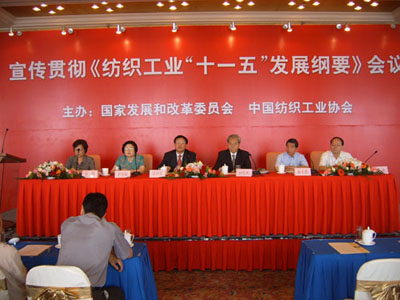
China newly released the 11th five-year
development plan for the textile industry rightly
points out the direction of its growth.
The plan requires textile manufacturers to improve
their ability to innovate, develop high-tech products
and those with higher added value, and promote
branding.
The plan, drawn up by the National Development
and Reform Commission, China National Textile
and Apparel Council and local government agencies,
marks a much-needed shift of focus from quantity
to quality in our textile development policies.
The elimination of global quotas on textile product
exports has facilitated China's textile exports
since early last year. Its textile exports accounted
for 25 per cent of the global total last year,
10 percentage points higher than five years ago.
According to the new development plan, by 2010,
China's textile exports are expected to increase
by over 50 per cent compared to last year.
But against the backdrop of these soaring exports
is the low technological level of the domestic
textile industry.
We mostly manufacture low-end products. The large
production volume may help us grab a slice of
the overseas market, but it also brings trade
frictions.
US and European textile producers have been filing
complaints about overseas competitors, including
Chinese manufacturers. The Western manufacturers
are beset with problems related to high labour
costs, industrial upgrading and restructuring.
It is irrational and violates fair trade rules
for them to lobby policy-makers to impose restrictions,
mainly anti-dumping charges or safeguard measures,
on textile imports from China.
Nevertheless, a new development strategy is badly
needed for our textile sector.
Trade frictions aside, an inability to mass-produce
high-end products would undermine the long-term
sustainability of the domestic textile industry.
Now that the domestic labour costs and raw material
prices are rising, the renminbi has appreciated
and the tax rebate for textile exports may be
further cut, domestic manufacturers must adopt
an innovation-oriented strategy if they want to
survive and stand out from the competition.
To that end, technological improvement must be
promoted and more attention must be paid to branding,
a field that can create huge added value but has
been largely shunned by domestic manufacturers
as they can make quick profits through the mass
production of low-end products.
The State now needs to issue follow-up measures
that will make this plan truly innovation-centred.
This ambitious blueprint will not play its due
role without such concrete measures.
Source:CCPIT TEX
|